


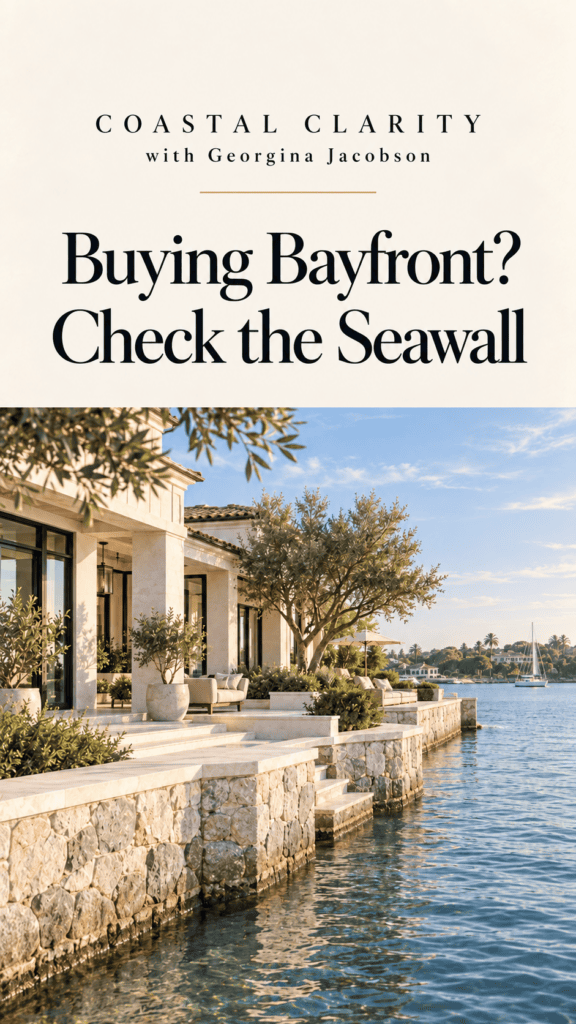
Coastal Clarity with Georgina
Buying a Bayfront Home: Why I Recommend a Seawall Inspection
Yes, I recommend a seawall inspection before buying a bayfront home. Review the structure’s condition alongside its available permit, repair and maintenance history so you can evaluate the waterfront responsibilities clearly.

Watch Georgina answer this question in Coastal Clarity.
Key takeaways
- Arrange an inspection by an appropriately qualified waterfront specialist.
- Request available permits and construction, repair and maintenance records.
- A remaining-life estimate is a planning opinion, not a guarantee.
- Discuss material findings with your transaction and insurance professionals.
When my bayfront buyers ask whether they should obtain a seawall inspection, my answer is yes. The waterfront setting may be the first thing that attracts you to a property, but understanding the structure at the water’s edge is an essential part of evaluating the purchase. I want buyers to have a clear picture of the questions, records and potential responsibilities involved before they complete the transaction.
In this Coastal Clarity episode, I discuss seawall history, permits, repairs and condition. Those details can influence your negotiations and the questions you need to ask an insurance professional. The right investigation brings the waterfront structure into the same careful review as the home itself.
Look beyond the appearance of the waterfront
A beautifully presented terrace or dock can make a bayfront property feel ready to enjoy. The condition of the seawall deserves a separate professional assessment. I would not use the appearance of the landscaping or a recently refreshed surface as evidence that every underlying component is in good condition.
The first step is to identify a qualified specialist whose experience fits the structure and the site. Ask what the inspection includes, what access is required and whether any portions will remain unobserved. The scope should be clear before you rely on the report.
I also recommend asking how the findings will be communicated. Photographs, descriptions of observed conditions and an explanation of limitations can help you understand what the specialist has established and which questions still need investigation.
Reconstruct the seawall’s history
In my video, I emphasize the history of the seawall. I would request whatever the seller can provide about construction, repairs, maintenance and previous evaluations. Dates, invoices, plans and inspection reports can help establish a more useful picture than a general statement that work was done.
The next question is whether those records relate to the entire structure or only a particular section. A repair in one location does not necessarily explain the condition of everything along the property frontage. Ask the specialist to distinguish documented work from assumptions about areas that were not part of the project.
If the records are incomplete, that is a reason to ask further questions. It does not establish a diagnosis by itself. I would want the appropriate professional to explain what can be learned through additional observation or document research and what uncertainty may remain.
Review permits alongside the physical inspection
Permit history and current condition answer different questions. Available approvals can help explain what work was proposed and authorized. The physical inspection addresses what the specialist can observe today. Neither should be treated as a complete substitute for the other.
Newport Beach provides permit and plan-check information with address-based research options. For waterfront work, I would also consult the City’s harbor-related permit resources and ask the relevant department which records apply to the property.
The useful questions are specific: what was the approved scope, what inspections or completion records are available, and does the visible configuration raise questions that require clarification? A qualified professional and the responsible agency can help interpret those records without turning a document search into a blanket assurance about the structure.
Understand condition and the limits of a lifespan estimate
Buyers naturally want to know how long a seawall will last. I understand why that matters when you are considering a waterfront purchase. A specialist may be able to discuss observed deterioration, maintenance needs and an estimated planning horizon, but an estimate is not a guarantee of remaining life.
Ask which findings support the specialist’s opinion and which conditions could change it. It is also useful to separate recommendations for immediate attention from ongoing monitoring or longer-term planning. That distinction makes a report easier to use in a purchase decision.
I would rather have a clear explanation of uncertainty than a confident number without supporting context. If the inspection leaves a material issue unresolved, ask whether additional evaluation is warranted before reaching the relevant decision point in your agreement.
Translate findings into a practical ownership plan
An inspection becomes more useful when you understand what the findings could mean for ownership. If work is recommended, ask an appropriately qualified contractor or engineer to explain the possible scope. Clarify what further design, access or approval questions would need to be resolved before a reliable proposal could be prepared.
I would avoid assuming that every waterfront repair is a quick or purely cosmetic project. The specific structure, access and permitting requirements need to be evaluated. Even an early discussion should distinguish a preliminary allowance from a detailed written estimate.
Consider the effect on the way you intend to use the property as well. If work could affect the terrace, dock access or another waterfront feature, that belongs in your planning. Understanding those practical consequences helps you evaluate the complete property rather than only the house’s interior.
Use the information in negotiations thoughtfully
Seawall findings can affect the conversation between buyer and seller, but a report does not automatically produce a particular credit or price adjustment. The parties’ options depend on the agreement, timing, findings and willingness to negotiate.
I would first organize the evidence. What has been confirmed? What is the recommended next step? Are there reliable proposals, or are we still discussing a possibility? A clear explanation gives the other side a more concrete basis for responding than a broad statement that the waterfront needs attention.
The same discipline helps buyers decide whether the home remains the right fit. Some buyers are comfortable managing a project after closing; others are seeking a property with fewer immediate unknowns. My goal is to help you understand the choice in relation to your own priorities.
Bring your insurance professional into the conversation
In the video, I mention insurability because I want buyers to ask about the waterfront components early. Tell your licensed insurance broker what structures are present and share relevant findings when requested. Ask whether the seawall or dock is addressed by the proposed coverage and what limitations apply.
An inspection does not guarantee that coverage will be available, and a homeowners quote should not be assumed to answer every waterfront question. The broker or insurer needs to evaluate the actual property and policy. Keep that review coordinated with the other escrow investigations.
My seawall due-diligence checklist
- Identify the structure and arrange an appropriately scoped specialist inspection.
- Request the seller’s available construction, repair and maintenance records.
- Review relevant permits and available completion information.
- Separate observed conditions from estimates and unresolved questions.
- Obtain further professional evaluation or proposals when recommended.
- Discuss the findings with your insurance professional and transaction team.
For buyers exploring Newport Beach, a bayfront setting can offer a distinctive way of life. My neighborhood guide can help you compare locations, while property-specific inspections help you understand the responsibilities attached to the individual home.
Talk through a bayfront purchase with me
If you are considering a waterfront home, I would be happy to help organize the questions that deserve attention before you proceed. Contact me or call or text 949-285-8380. You can also watch the full Coastal Clarity with Georgina series for more answers to coastal property questions.
Frequently asked questions
Is a general home inspection enough to evaluate a seawall?
Ask what the inspector’s scope includes. A seawall may require a qualified specialist and a separate evaluation of waterfront components.
Can an inspection guarantee how long a seawall will last?
No. A professional may provide an estimate based on observed conditions, but remaining life is not guaranteed.
Which records should I request?
Request available construction plans, permits, repair invoices, maintenance records and prior evaluations, then compare them with the specialist’s current findings.
Explore related pages
About Georgina Jacobson
Georgina Jacobson is a Newport Beach luxury real estate specialist with more than three decades of experience representing buyers and sellers in Newport Beach, Newport Coast, Corona del Mar, Laguna Beach and coastal Orange County. She leads the Georgina Jacobson Group with Coldwell Banker Realty. California DRE #01176109.
Let’s discuss your coastal property goals
I would be happy to talk through your priorities and the questions surrounding your next purchase or sale.
Research and useful resources
- permit and plan-check information with address-based research options
- harbor-related permit resources
Official resources checked September 11, 2026. Confirm current property-specific requirements with the responsible agency or licensed professional.