


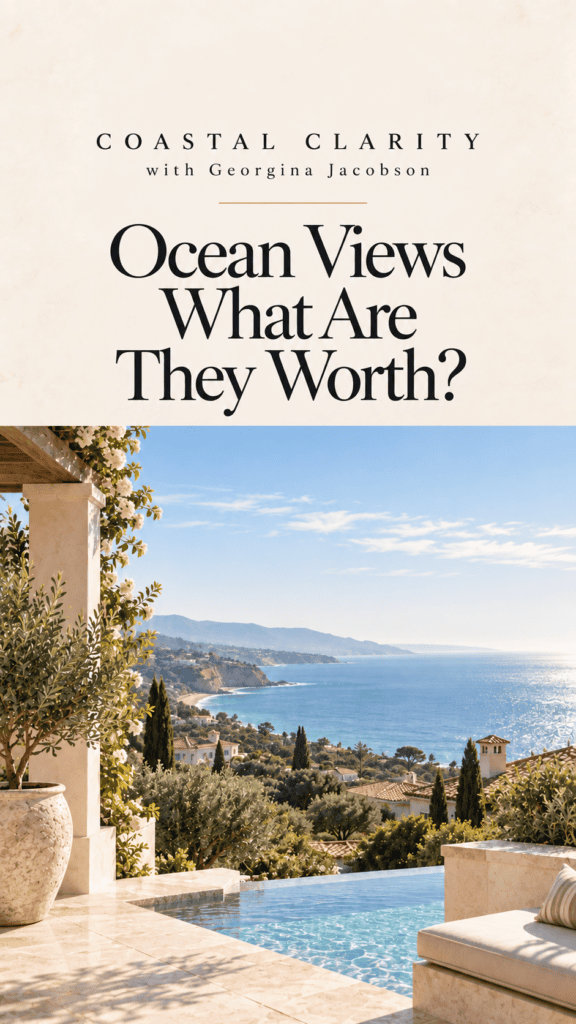
Coastal Clarity with Georgina
What Is an Ocean View Worth? Look at Obstructions and Future Development
An ocean view’s value depends on what you can actually see and enjoy. I consider rooftops, trees and possible future development alongside the home’s location, condition and other features.

Watch Georgina answer this question in Coastal Clarity.
Key takeaways
- Evaluate the view from the rooms and seated positions you will use.
- Describe foreground obstructions precisely.
- Research known nearby development and verify claims of view protection.
- Avoid assigning one universal premium to all ocean-view properties.
Buyers often ask me how much an ocean view is really worth. My answer begins with the view itself. Is it a broad, unobstructed panorama? Are rooftops or trees part of the foreground? Could construction nearby change what you see? Those details deserve a closer look before an ocean-view description becomes a reason to pay more for a home.
In this Coastal Clarity video, I focus on obstructions and possible future development. An ocean view can be a meaningful part of a coastal property’s appeal, but the value discussion needs to reflect its quality, how you experience it and the uncertainty surrounding it. I would not apply a single percentage to every home with water in sight.
Start with what you can see from the home
The first question is simple: where do you actually experience the view? Walk through the rooms and outdoor areas you expect to use most. Notice whether the ocean is visible from the main living space, dining area, primary bedroom or terrace, and whether you need to stand in a particular position to see it.
I encourage buyers to spend a little time in those places rather than only walking directly toward the most dramatic window. A view that is part of daily life may feel different from one available only from a secondary room or a small corner of a balcony.
Photographs can help you discover a property, but your own visit is essential. Compare the impression created by the images with the experience from normal standing and seated positions. The aim is to understand the view as you will live with it.
Describe the obstructions precisely
Rooftops, trees and neighboring buildings can influence the experience in different ways. I would avoid treating every partial obstruction as equivalent. Ask how much of the view is affected, where the obstruction sits and whether it interrupts the part of the outlook that matters most to you.
A buyer may enjoy the texture of a neighborhood in the foreground while another prioritizes an uninterrupted horizon. Neither preference needs to be universal. What matters is recognizing the difference and understanding how it relates to your own expectations and the property’s price.
It helps to write a short description after each showing. Note the rooms with the view, the main foreground features and any places where the outlook changes as you move. Those notes make later comparisons more reliable than trying to remember which home felt most open.
Separate today’s view from assumptions about tomorrow
In my video, I recommend paying attention to future construction around the property. The view you see today does not, by itself, establish that the outlook will remain unchanged. A vacant parcel, a lower neighboring home or a gap between buildings deserves investigation if it is important to your purchase.
I would ask what is known about nearby projects and then verify the information through the responsible planning or building department. Distinguish an approved plan, a pending proposal and a general possibility. Those are different levels of information and should not be combined into one prediction.
For Newport Beach, the City’s permit and plan-check information is one starting point for researching activity associated with an address. Ask staff which records or planning resources are relevant to the neighboring sites you are investigating.
Ask what protects the view, if anything
If someone describes a view as protected, I would want to understand the basis for that statement. Is there a recorded provision, an applicable approval condition, an association restriction or another document? What does the actual language cover, and who can explain its application?
The title company and a qualified attorney can help investigate legal questions about documents and rights. Planning staff can explain applicable regulations. I would not interpret a marketing phrase as a legal guarantee or assume that a height limit alone answers every question about a future sightline.
The same care applies to trees and landscaping. Ask who controls the vegetation and whether any enforceable provisions are relevant. A neighbor’s current maintenance practice or informal understanding should be evaluated for what it is, without assuming it creates a permanent right.
Visit at different times and conditions
The quality of an outlook can change with light, weather and the way the home is used. I recommend returning when practical so you can compare the property under more than one set of conditions. Notice glare, shade and the relationship between the interior and the view.
Sit where you would read, dine or spend time with guests. Look at what remains visible when furniture is arranged naturally. A dramatic moment at a showing is useful, but I also want buyers to understand the quieter, everyday experience.
For buyers considering different coastal settings, my pages on Newport Coast and Laguna Beach can help introduce the broader communities. The individual property visit is where you evaluate the actual outlook, exposure and surroundings.
Use comparable sales with the view differences in mind
When discussing value, I would compare the home with relevant sales while accounting for differences in the view and the rest of the property. Two homes described as ocean-view properties may offer very different experiences from their main living areas.
Location, condition, size and layout still matter. It is easy to give the view credit for the entire price difference between two homes when other features also contribute. A thoughtful comparison should make those differences explicit rather than attach an unsupported premium to the word ocean.
I would also be careful with broad averages. A market-wide figure cannot tell you exactly what a particular buyer will pay for a particular sightline. The objective is a reasoned assessment supported by the available evidence, with uncertainty acknowledged where the comparisons are limited.
Consider the property if the outlook changes
One question I find useful is whether the home would still meet your needs if part of the view changed. You may still value the neighborhood, floor plan, outdoor space and privacy. Alternatively, a specific sightline may be central to the reason you are considering the property.
That distinction can influence how much investigation you need and how you approach the price. If the purchase depends heavily on one feature, unresolved questions about that feature deserve particular attention. I would rather identify the dependency early than let it remain an unspoken assumption.
This does not mean expecting every possible future event to be predictable. It means making a decision with a clear understanding of what has been confirmed, what remains uncertain and how that uncertainty fits your priorities.
My ocean-view review checklist
- Identify the rooms and outdoor spaces where the view is actually enjoyed.
- Describe the rooftops, trees or other foreground obstructions.
- Research known nearby development with the responsible agency.
- Verify the basis of any claim that the view is protected.
- Revisit the home under different light conditions when possible.
- Compare relevant sales without assuming every ocean view has the same premium.
Let us evaluate the view in context
If you are considering an ocean-view home, I would be happy to discuss the outlook alongside the property’s location, condition and fit for your life. Contact me or call or text 949-285-8380. Watch the other questions in Coastal Clarity with Georgina for more of my approach to coastal real estate.
Frequently asked questions
Is there a fixed percentage premium for an ocean view?
I would not use a universal percentage. The view needs to be evaluated alongside the property and relevant comparable sales.
Is an existing view automatically protected?
No. Verify the basis for any protection claim through the relevant documents, agencies and qualified advisers.
What should I investigate about neighboring construction?
Identify known projects or proposals and confirm their status with the responsible department. Separate approved plans from possibilities or informal comments.
Explore related pages
About Georgina Jacobson
Georgina Jacobson is a Newport Beach luxury real estate specialist with more than three decades of experience representing buyers and sellers in Newport Beach, Newport Coast, Corona del Mar, Laguna Beach and coastal Orange County. She leads the Georgina Jacobson Group with Coldwell Banker Realty. California DRE #01176109.
Let’s discuss your coastal property goals
I would be happy to talk through your priorities and the questions surrounding your next purchase or sale.
Research and useful resources
Official resources checked September 11, 2026. Confirm current property-specific requirements with the responsible agency or licensed professional.