


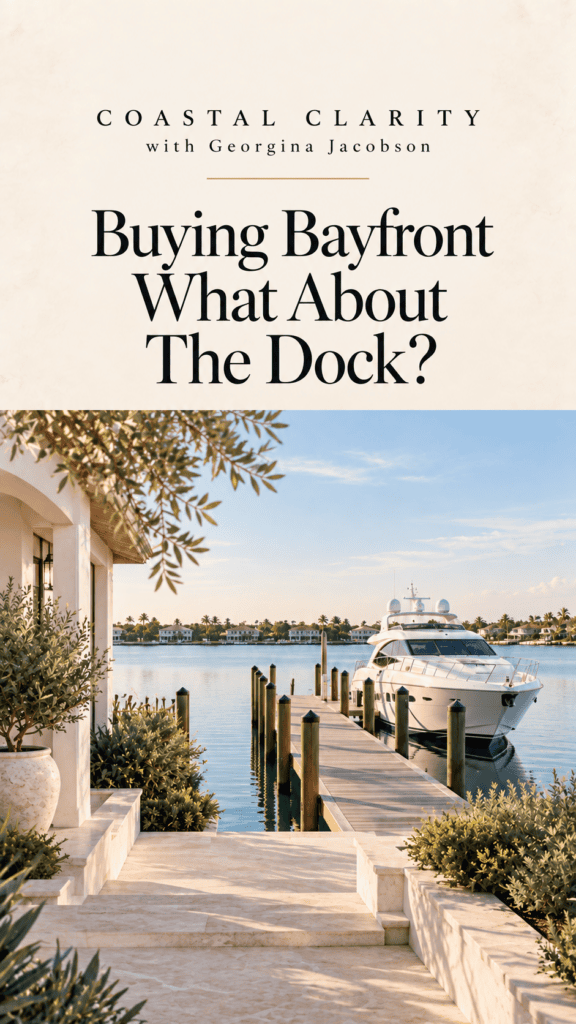
Coastal Clarity with Georgina
Buying a Newport Beach Home With a Dock: My Buyer Checklist
A dock should work for your boat and come with a clear understanding of the relevant rights and responsibilities. I investigate permits, tidelands arrangements, vessel fit, utilities and waterfront condition together.

Watch Georgina answer this question in Coastal Clarity.
Key takeaways
- Confirm what dock rights and agreements are included with the property.
- Verify the responsible agency and current transfer requirements.
- Check vessel dimensions, draft, access, water and power.
- Inspect the dock and seawall and understand ongoing obligations.
One question I am asked about bayfront property is what a buyer should look for when the home includes a dock. My answer begins with both the paperwork and the practical fit. A dock is an appealing part of waterfront living, but I want to know what rights and responsibilities are involved and whether the arrangement works for the boat you intend to use.
In my Coastal Clarity video, I discuss tidelands arrangements, dock permits, vessel dimensions, water and power, and seawall condition. Each deserves a direct investigation. A listing photograph cannot tell you everything you need to know about the waterfront portion of a purchase.
Understand exactly what comes with the property
Start by asking what the seller means when describing the home as having a dock. Request the relevant plans, permits, agreements and available records. I want the buyer to understand the physical structure and the documented rights associated with its use.
Distinguish a residential dock connected with the property from other boating arrangements, such as a separately held mooring or a rented marina slip. Those arrangements should not be treated as interchangeable. The documents and responsible agency need to establish what is actually involved in the sale.
I would also ask whether there are shared access provisions, maintenance arrangements or other conditions affecting the dock. Where a question involves title or interpretation of an agreement, bring in the title company and appropriate legal adviser instead of relying on a casual description.
Verify the tidelands and permitting arrangements
In the video, I mention that some areas involve tidelands leases and transfers through escrow. The correct process depends on the specific property and the authority responsible for it. I would verify the actual arrangement rather than apply one explanation to every Newport Harbor address.
The City’s Harbor Tideland Charges information explains that much of Lower Newport Harbor’s tidelands is publicly owned and administered by the City on the State’s behalf. That makes it important to distinguish ownership of the upland home from permission to use the adjacent tidelands.
Ask which permits or agreements apply, whether charges are current and what must occur when the home changes hands. Obtain the current instructions from the responsible agency. I would make that process an explicit part of the transaction timeline rather than assume it happens automatically with the deed transfer.
Review current requirements, not just older paperwork
Historical permits are useful, but I also want buyers to confirm the current requirements. The City provides harbor-related permit resources for dock, pier and other waterfront questions. Ask the appropriate department what applies to the existing structure and the proposed change of ownership.
Harbor policies and charges can evolve. Newport Beach’s Newport Harbor policy review page describes ongoing consideration of tidelands management issues. Review current information with the agency rather than relying on an old fee schedule or assuming that a discussion of future policy is already an adopted rule.
For your purchase, the key is to identify what is required now, what has been formally communicated and what remains uncertain. That keeps the review grounded in the property and avoids treating a general harbor conversation as a definitive answer about one dock.
Match the slip to your actual boat
A dock that looks generous in a photograph may not suit a particular vessel. In my video, I call attention to length, width and depth. Bring the actual boat specifications into the investigation and have the fit assessed by an appropriate marine professional when needed.
Consider overall length and beam, draft, available clearances and the way the boat would be positioned. Ask about water depth under relevant tidal conditions and the practical approach to the slip. Do not infer suitability from the size of a vessel that happens to be pictured at the property.
I would also think about the experience of using the boat regularly. Getting aboard, handling lines, carrying supplies and navigating the approach all matter. If boating is central to the purchase, these details deserve the same attention as the layout of the home.
Check water, power and everyday usability
Water and shore power are among the features I mention because buyers should know what is actually available. Ask a qualified professional to assess the condition and suitability of the facilities for the intended use. The presence of an outlet or hose connection does not answer every technical question.
I would also review the route between the house and the dock. Look at access, storage and the practical arrangements for maintaining the boat and waterfront area. These observations can help you identify questions for the inspection and compare one property with another.
If you anticipate changing the dock or utilities, investigate that proposal separately. An existing configuration does not establish that a different layout or larger vessel can be accommodated. Clarify the design and approval questions before making the future arrangement part of your purchase assumptions.
Inspect the dock and the seawall as distinct components
The dock and seawall contribute to the same waterfront experience, but they may require different scopes of inspection. I recommend identifying qualified professionals who can evaluate the relevant structures and explain what has and has not been observed.
Request available records of construction, repairs and maintenance. Ask the inspector to distinguish current condition from estimated future needs. If additional evaluation is recommended, determine what it would involve and how it fits within the transaction’s deadlines.
I would also ask how any recommended work could affect access or use. A proposal should explain its assumptions, and a preliminary estimate should not be mistaken for a fixed commitment. Understanding the likely process helps you evaluate the ownership responsibilities more realistically.
Put the costs and coverage questions together
Beyond the purchase price, investigate applicable permit or tidelands charges, maintenance obligations and insurance requirements. Ask which expenses relate to the home, the dock and the boat, and confirm them with the appropriate professionals or agencies.
Tell your licensed insurance broker about the waterfront structures and intended use. Ask what the proposed policies address and whether separate coverage or specific conditions apply. I would avoid assuming that the home’s coverage automatically includes every aspect of the dock or boating arrangement.
My Newport Beach neighborhood guide can help you compare waterfront settings. The individual property review then brings together the documents, vessel fit, condition and ongoing responsibilities that make one home suitable for your needs.
The questions I would resolve before closing
- What documented dock and tidelands rights are included with the purchase?
- Which agency administers them, and what transfer process applies?
- Does the actual vessel fit the slip and approach under relevant conditions?
- Are the water and power facilities appropriate for the intended use?
- What do the dock and seawall inspections establish?
- What charges, maintenance obligations and coverage requirements apply?
Find the right waterfront fit with me
If you are searching for a Newport Beach home with a dock, I would be happy to discuss your boating priorities and help organize the property questions. Contact me or call or text 949-285-8380. Watch more coastal property Q&As in Coastal Clarity with Georgina.
Frequently asked questions
Will any boat fit a dock advertised with a home?
No. Compare the actual vessel’s dimensions and draft with the slip, approach and relevant conditions, using an appropriate marine professional when needed.
Are all Newport Harbor tidelands arrangements the same?
No. Verify the property’s documents, responsible authority, charges and current transfer requirements rather than applying one process to every address.
Should I investigate the seawall as well as the dock?
Yes. They may require distinct inspection scopes. Review available records and understand the condition and responsibilities of both components.
Explore related pages
About Georgina Jacobson
Georgina Jacobson is a Newport Beach luxury real estate specialist with more than three decades of experience representing buyers and sellers in Newport Beach, Newport Coast, Corona del Mar, Laguna Beach and coastal Orange County. She leads the Georgina Jacobson Group with Coldwell Banker Realty. California DRE #01176109.
Let’s discuss your coastal property goals
I would be happy to talk through your priorities and the questions surrounding your next purchase or sale.
Research and useful resources
- Harbor Tideland Charges information
- harbor-related permit resources
- Newport Harbor policy review page
Official resources checked September 11, 2026. Confirm current property-specific requirements with the responsible agency or licensed professional.